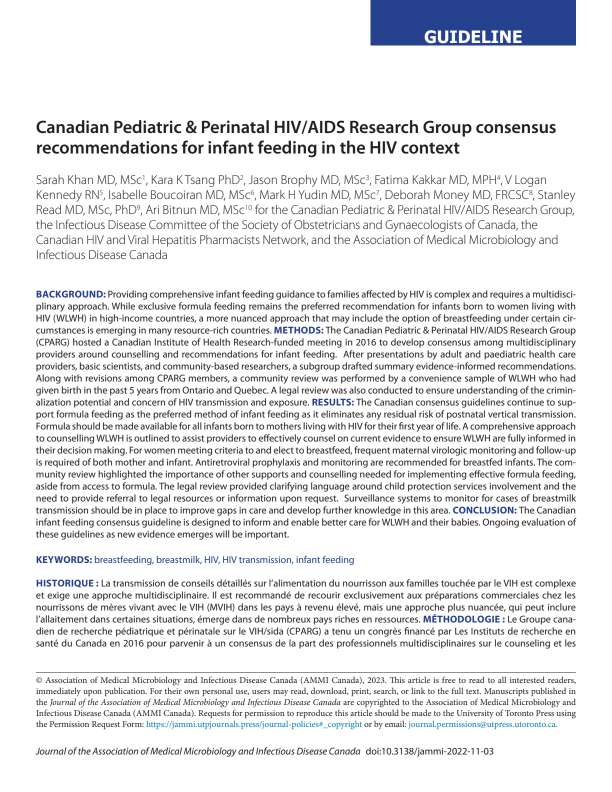




recommendations for infant feeding in the HIV context
Sarah Khan MD, MSc1
, Kara K Tsang PhD2
, Jason Brophy MD, MSc3
, Fatima Kakkar MD, MPH4
, V Logan
Kennedy RN5
, Isabelle Boucoiran MD, MSc6
, Mark H Yudin MD, MSc7
, Deborah Money MD, FRCSC8
, Stanley
Read MD, MSc, PhD9
, Ari Bitnun MD, MSc10
for the Canadian Pediatric & Perinatal HIV/AIDS Research Group,
the Infectious Disease Committee of the Society of Obstetricians and Gynaecologists of Canada, the
Canadian HIV and Viral Hepatitis Pharmacists Network, and the Association of Medical Microb iology and
Infectious Disease Canada
BACKGROUND: Providing comprehensive infant feeding guidance to families affected by HIV is complex and requires a multidisciplinary
approach. While exclusive formula feeding remains the preferred recommendation for infants born to women living with
HIV (WLWH) in high-income countries, a more nuanced approach that may include the option of breastfeeding under certain circumstances
is emerging in many resource-rich countries. METHODS: The Canadian Pediatric & Perinatal HIV/AIDS Research Group
(CPARG) hosted a Canadian Institute of Health Research-funded meeting in 2016 to develop consensus among multidisciplinary
providers around counselling and recommendations for infant feeding. After presentations by adult and paediatric health care
providers, basic scientists, and community-based researchers, a subgroup drafted summary evidence-informed recommendations.
Along with revisions among CPARG members, a community review was performed by a convenience sample of WLWH who had
given birth in the past 5 years from Ontario and Quebec. A legal review was also conducted to ensure understanding of the criminalization
potential and concern of HIV transmission and exposure. RESULTS: The Canadian consensus guidelines continue to support
formula feeding as the preferred method of infant feeding as it eliminates any residual risk of postnatal vertical transmission.
Formula should be made available for all infants born to mothers living with HIV for their ffrst year of life. A comprehensive approach
to counselling WLWH is outlined to assist providers to effectively counsel on current evidence to ensure WLWH are fully informed in
their decision making. For women meeting criteria to and elect to breastfeed, frequent maternal virologic monitoring and follow-up
is required of both mother and infant. Antiretroviral prophylaxis and monitoring are recommended for breastfed infants. The community
review highlighted the importance of other supports and counselling needed for implementing effective formula feeding,
aside from access to formula. The legal review provided clarifying language around child protection services involvement and the
need to provide referral to legal resources or information upon request. Surveillance systems to monitor for cases of breastmilk
transmission should be in place to improve gaps in care and develop further knowledge in this area. CONCLUSION: The Canadian
infant feeding consensus guideline is designed to inform and enable better care for WLWH and their babies. Ongoing evaluation of
these guidelines as new evidence emerges will be important.
KEYWORDS: breastfeeding, breastmilk, HIV, HIV transmission, infant feeding





暂无评论内容